What’s trending for school social media in 2026?
Is it Instagram Reels? Student-created content? Taking a step back from certain platforms? Making accessibility a priority?
These questions are on every school communicator’s mind as we navigate the ever-evolving social media landscape. To get real answers, we went straight to the source – you!
Our 2026 Social Media Survey gathered insights from 497 school communicators across the country. From platform preferences to student involvement and accessibility readiness, we uncovered what’s really happening in school social media today.
Some key questions we explored:
- What challenges are universal across districts?
- How many schools are actively involving students in content creation?
- Are schools ready for the upcoming new accessibility standards?
- What tools and resources are helping communicators stay current?
The results paint a fascinating picture of where school social media stands in 2026. Whether you’re a seasoned communications director or completely new to school PR, these insights will help you benchmark your efforts and plan your strategy moving forward.
Interested in past data? Here’s where you can find it:
Would you rather watch me talk through these results with slides? Watch my video:
All right, we’re ready! Let’s dive into what we learned from our colleagues across the country.
Q1: What is Your Role Within Your School or District?
A baseline piece of data we always gather concerns the job function you have at your school. While social media is just one responsibility among many, this data helps understand who’s managing communications on behalf of schools and districts.
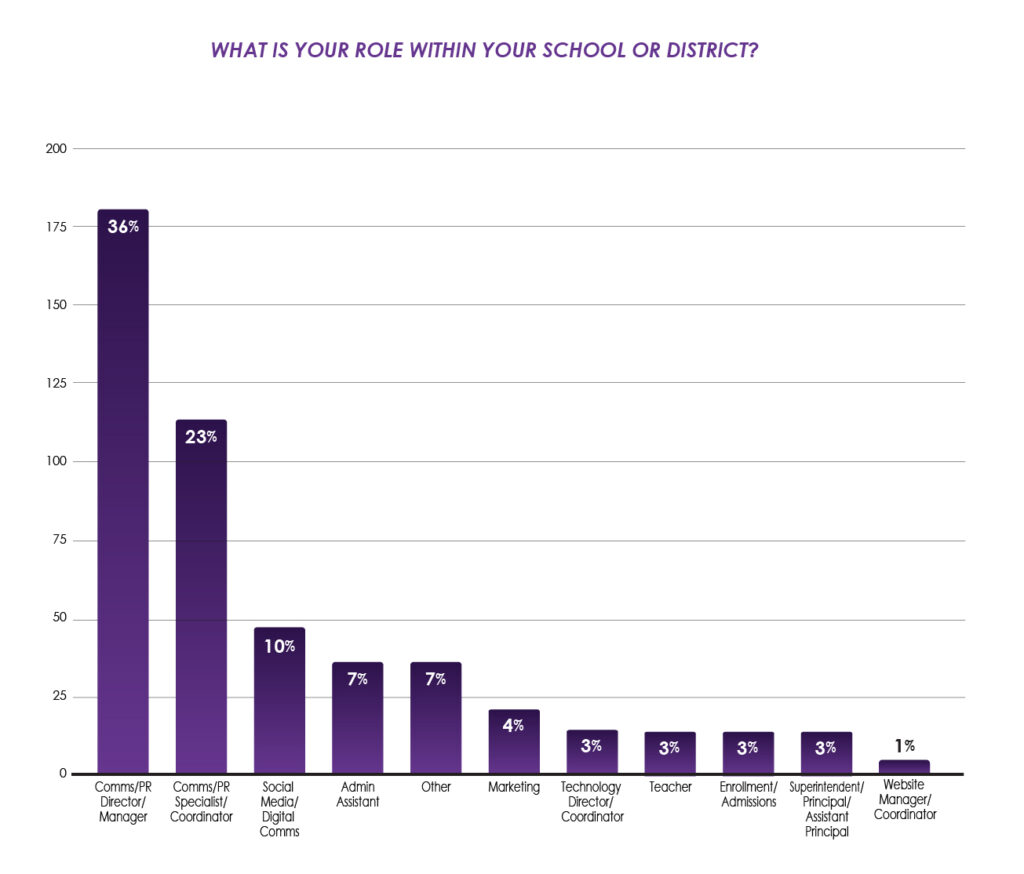
What is your role within your school or district?
- 36% – Communications or PR Director/Manager
- 23% – Communications or PR Specialist/Coordinator
- 10% – Social Media or Digital Communications
- 7% – Admin Assistant
- 7% – Other
- 4% – Marketing
- 3% – Technology Director or Coordinator
- 3% – Teacher
- 3% – Enrollment or Admissions
- 3% – Superintendent, Principal or Assistant Principal
- 1% – Website Manager or Coordinator
Over 50% of our respondents work in communications roles, showing that schools are prioritizing their investment in marketing and communications positions!
Q2: What Type of School Do You Work For?
Just as in question one, it’s valuable to get a sense of which types of schools are represented in our data. Sixty-nine percent of respondents work at public schools, and 21% work at private, independent, or religious schools. Here’s the rest of the data:
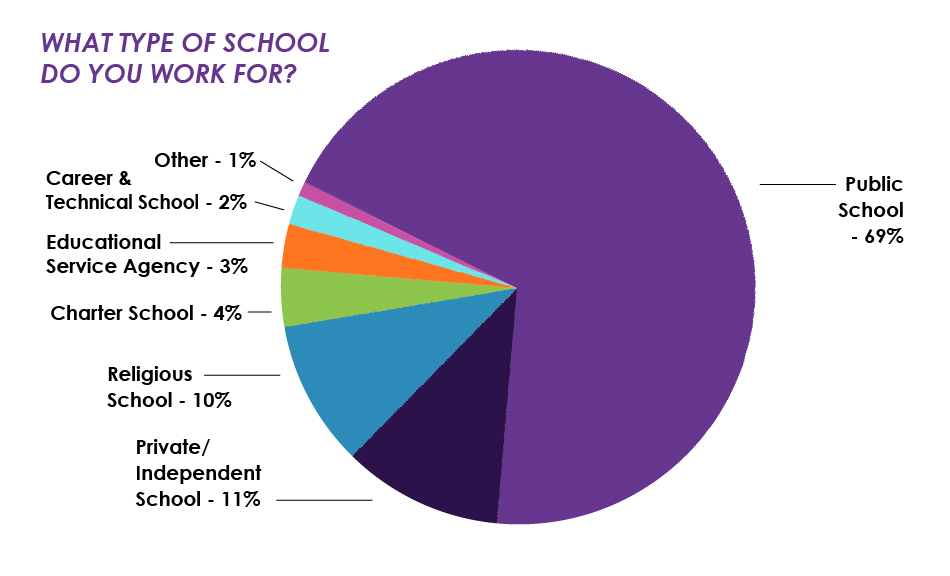
What type of school do you work for?
- 69% – Public
- 11% – Private/Independent
- 10% – Religious
- 4% – Charter
- 3% – Educational Service Agency
- 2% – Career & Technical School
- 1% – Other
Q3: How Long Have You Been Involved with Social Media?
Ninety-five percent of school communicators in our data have been in their roles for more than one year – but other than that, experience levels were evenly distributed in this year’s survey results!

How long have you been involved with social media for your school or district?
- 5% – Less than 1 year
- 24% – 1-3 years
- 25% – 3-5 years
- 24% – 6-10 years
- 22% – More than 11 years
The great thing about social media is that it doesn’t matter if you’re brand new or super seasoned – there’s always something fresh to learn! Social media continues to change, so you can’t ever say “I’ve arrived, and I’ve got it.” You really have to stay connected!
Q4: Which Social Media Channel(s) Do You Manage?
As a company dedicated to school social media, we need to know where schools are active online. Some districts post on more obscure platforms like Nextdoor and Bluesky, but the vast, vast majority are mainly utilizing Facebook and Instagram. My key takeaway in this section is that Facebook remains king of all the platforms, with Instagram in a close second place.
This should be reassuring to you!
If you’ve received requests to add TikTok or are worried about keeping up with Twitter/X, this data clearly shows that Facebook and Instagram deliver the strongest return on your time investment. As I often say… if you can only do one platform and do it well, make sure you’re using Facebook.

What social media channel(s) do you manage for your school or district?
- 98% – Facebook
- 86% – Instagram
- 50% – YouTube
- 43% – LinkedIn
- 34% – Twitter/X
- 9% – TikTok
- 5% – Threads
- 4% – Pinterest
- 3% – Nextdoor
- 2% – Snapchat
- 2% – Bluesky
- 1% – Other
Even more interesting is how this year’s data compares to past years:
- YouTube has seen a slight decline from 57% two years ago to 50% now.
- LinkedIn has grown from 37% in 2022 to 43% in 2026.
- Twitter/X has been on a steady decline*, from 74% in 2022 to 34% today.
- TikTok usage is going up, but it’s still only at 9% – so don’t feel pressure to go there!
*Of course, if you are still using Twitter/X and it makes sense for your district, great! But many schools have transitioned away from that channel to devote their attention elsewhere.
| 2026 | 2025 | 2023 | 2022 | |
| 98 | 98 | 96 | 98 | |
| 86 | 88 | 80 | 79 | |
| YouTube | 50 | 52 | 58 | 57 |
| Twitter/X | 34 | 48 | 57 | 74 |
| 43 | 45 | 41 | 37 | |
| TikTok | 9 | 6 | 8 | 4 |
How can you use this data? Well, it could be helpful to use this information to talk to your leadership team, especially if you’re getting some pushback from your school board or your cabinet, who are saying, “We have to be on more social media platforms.”
More isn’t always better! You have a lot on your plate, which is why I encourage you to use this data to back up what you’re doing.
Maybe it’s even time to remove a platform, knowing that you might be able to do a better job if you weren’t spreading yourself so thinly. Social media is all about engagement, and you really have to show up consistently to tell your school’s stories in a way that gets people to engage. Too many platforms, and you risk subpar results.
Q5: What Do You Love Most About School Social Media Storytelling?
I added a new question this year about what school communicators love most about their social media responsibilities!
When you work in social media, it’s not all rainbows and unicorns. It can be very challenging, and sometimes the simplest projects can turn out to be really complicated. But this list reminds me (and you!) that our job is actually pretty awesome!
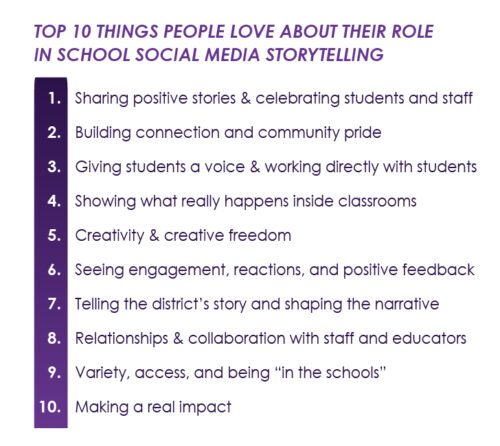
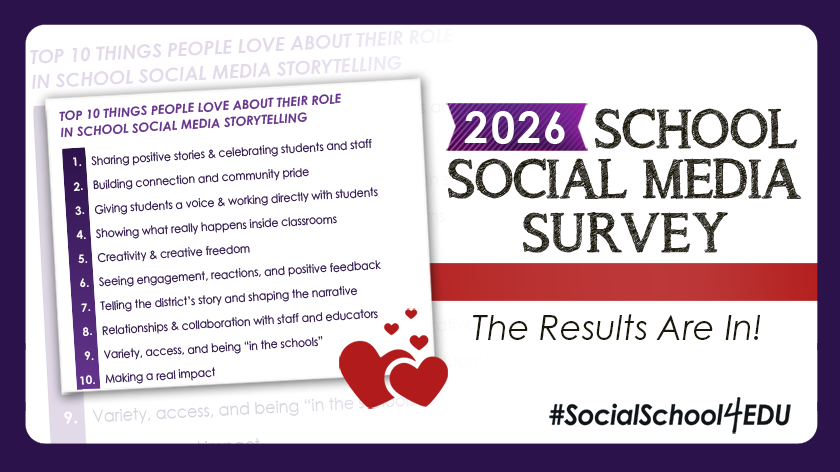
Top 10 things people love about their role in school social media storytelling
- Sharing positive stories & celebrating students and staff
- Building connection & community pride
- Giving students a voice & working directly with students
- Showing what really happens inside classrooms
- Creativity & creative freedom
- Seeing engagement, reactions, and positive feedback
- Telling the district’s story and shaping the narrative
- Relationships & collaboration with staff and educators
- Variety, access, and being “in the schools”
- Making a real impact
Keep this list at the forefront when the days get tough. This isn’t what you have to do, this is what you get to do! We have such a powerful role in shaping the experience that your students, staff, and wider community get to have with your school.
Q6: How Are Your Social Media Platform Set-up Skills?
How do you feel about your Meta Business Manager / Portfolio setup? Our results show a mixed bag!
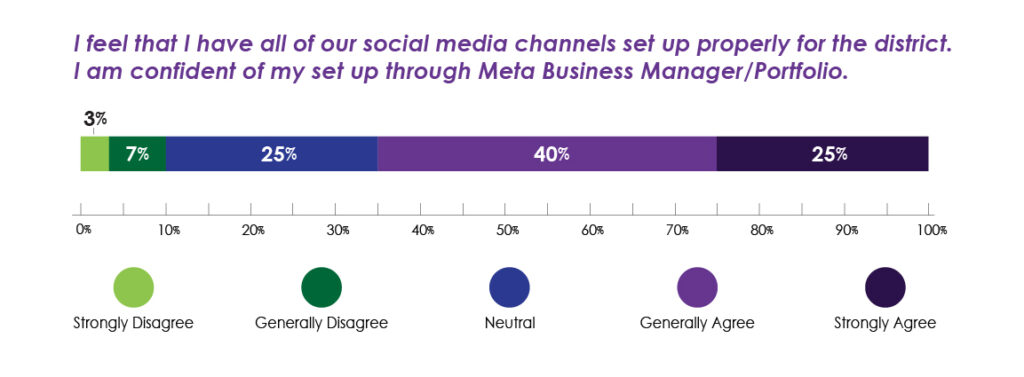
I feel that I have all of our social media channels set up properly for the district. I am confident of my setup through Meta Business Manager/Portfolio.
- 3% – Strongly Disagree
- 7% – Generally Disagree
- 25% – Neutral
- 40% – Generally Agree
- 25% – Strongly Agree
If you’re not sure how well you’re set up, now is the time to check. Read this helpful blog for a step-by-step guide.
Also, if you recently had someone switch positions, leave, or retire, this is a critical time to verify that all of your school’s Facebook and Instagram accounts are set up correctly in Meta. You don’t want to get locked out or lose access to the pages you’ve worked so hard to build!
If you’re still struggling or have some specific questions, you can schedule a 1:1 strategy session with me. Just reserve a time, and we can go over the setup of your Meta Business Portfolio together! Inside my membership program, these sessions are 100% free.
Q7: What is Your Self-Rating on Social Media Efforts?
I believe that if you’re putting in some effort on social media, you’re probably at least average. And I’m proud of you for what you’re doing!
Of course, there’s always room for improvement – which is true for me, too, and I’ve been doing this for 12 years – so keep honing your skills. What worked 2 or 3 years ago maybe doesn’t work anymore. I encourage you to stay up to date on the latest best practices.
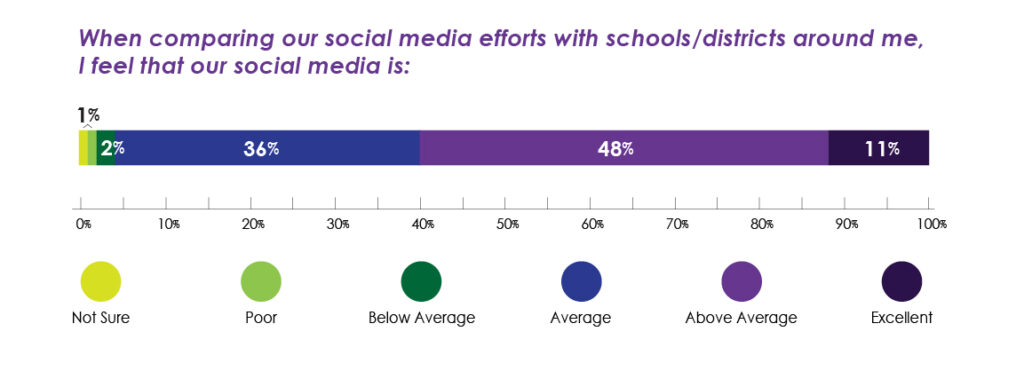
When comparing our social media efforts with schools/districts around me, I feel that our social media is:
- 11% – Excellent
- 48% – Above Average
- 36% – Average
- 2% – Below Average
- 1% – Poor
- 1% – Not Sure
Q8: What Are Your Biggest Challenges with School Social Media?
Comparing these responses to prior years, the biggest social media challenges haven’t really changed! I want you to understand that you’re not alone. If you’re struggling with these things, other people definitely are, too.

Top 10 biggest challenges with social media for your schools or districts
- Lack of time / capacity
- Getting content from staff
- Consistency
- Being understaffed / limited resources
- Quality content
- Staff & leadership buy-in
- Coverage equity
- Negative comments, trolls, and moderation concerns
- Accessibility, privacy, and compliance constraints
- Engagement & reach
I wouldn’t be doing my job if I didn’t offer additional resources and solutions to directly address these challenges:
Struggling with time and capacity?
My book is your #1 best resource.
Feeling overwhelmed with social media in general?
This blog addresses your feelings.
Wondering how to get more staff members to contribute content?
This blog and this blog offer practical solutions!
Scrambling to stay consistent?
Go back to the basics! Again, this blog breaks it all down, and I invite you to download this free resource for tried-and-true social media features that you can use continuously.
Faced with limited time/resources?
This one is all about mindset. Ground yourself in this truth: You don’t have unlimited time. Some social media experts push you to do “more, more, more – or else you’re missing out!” But authentic stories (especially student stories) win every time.
In some moments, we can even feel paralyzed by uncertainty, so write down these two quotes:
“Posted is better than perfect and unpublished.” – Ren Luebbering (Give yourself grace to just put something out there!)
“Trends fade, trust doesn’t. It’s not about going viral, it’s about building trust.” – Alice Seuffert (Focus on building trust one post and one short, imperfect video at a time.)
Wishing you had more staff?
Involving students may be a great way to add capacity to your department! It might be overwhelming at first (and I still don’t have it perfectly worked out) but many schools have gotten amazing content from student contributors.
Q9: Do You Support Multiple Schools?
Many school communicators work in small schools with just one building, one Facebook page, etc. And some school PR pros are in really big school districts with 50,000+ students, where every school has a social media manager on-site!
With that being said, out of our survey respondents, 39% of you are responsible for training other social media folks in your school or district, and 61% are not.
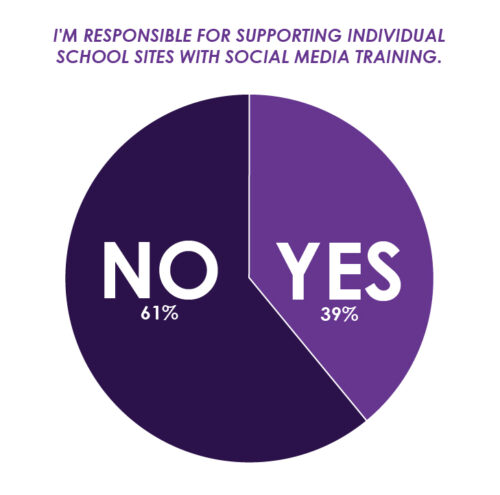
I’m responsible for supporting individual school sites with social media training.
- 61% – No
- 39% – Yes
For the 39% who answered “Yes”, #SocialSchool4EDU has a TON of helpful resources and an affordable membership program to help with that responsibility!
Then, if respondents answered “yes,” we had a few follow-up questions:
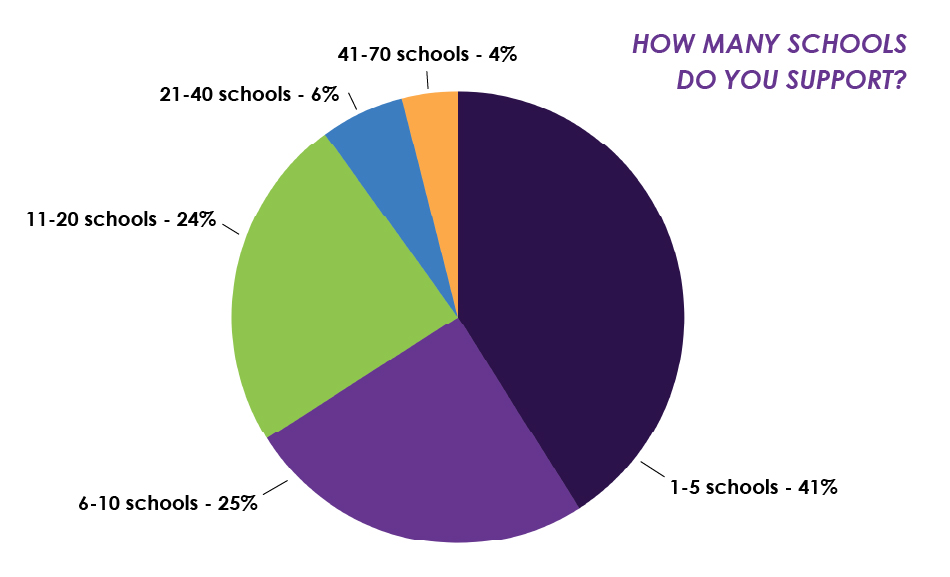
How many schools do you support?
- 41% – 1-5 schools
- 25% – 6-10 schools
- 24% – 11-20 schools
- 6% – 21-40 schools
- 4% – 41-70 schools
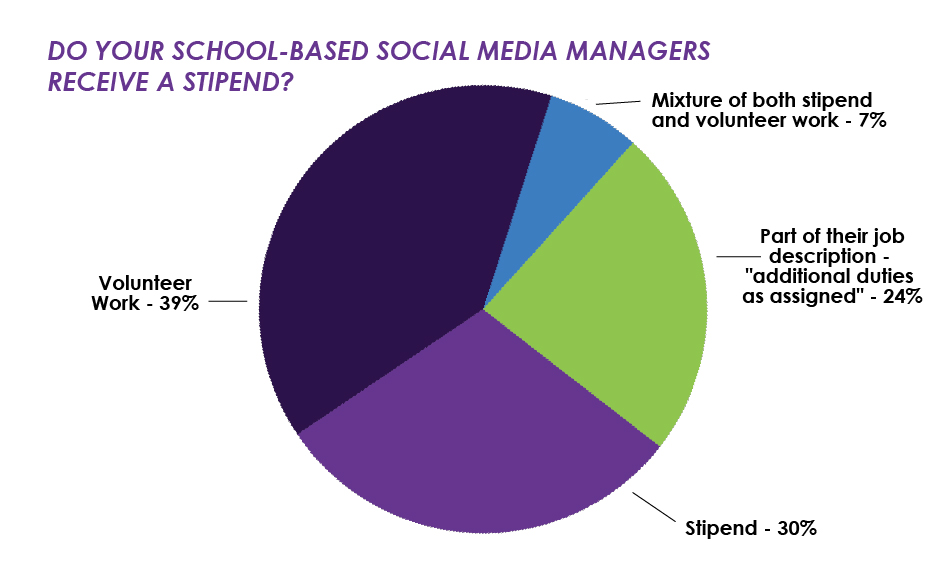
Do your school-based social media managers receive a stipend or is it just volunteer work?
- 39% – Volunteer work
- 30% – Stipend
- 24% – It’s part of their job description – “additional duties as assigned”
- 7% – Mixture of both stipend and volunteer work
Social media is incredibly valuable from a financial standpoint, but not all schools put dollars behind it. If your school has multiple social media managers, this data can help you understand how other districts handle the compensation.
Q10: Are You Prepared to Meet Accessibility Standards?
For the 2026 survey, I added this additional brand-new question. A new accessibility standard is coming out, and I wanted to gauge how ready school communicators feel. Public schools and government organizations will soon need to meet WCAG 2.1 AA standards across all digital content, which includes social media and websites.
Private schools won’t be held to these standards; however, it remains a best practice to ensure your digital materials are accessible to everyone, regardless of vision, hearing, or reading levels. We want to make sure our stories are accessible!
Click here for my comprehensive overview of the new accessibility standards, including what school communicators need to know and upcoming deadlines. I also interviewed Zac Rantz on my podcast, where he provided an accessibility checklist for schools.
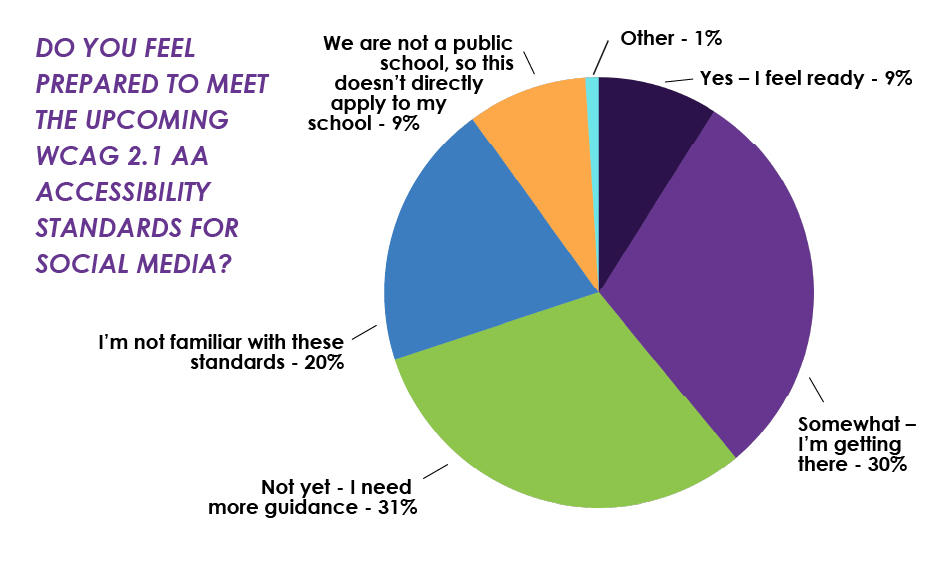
Do you feel prepared to meet the upcoming WCAG 2.1 AA accessibility standards for social media (effective April 2026/2027, depending on district size)?
- 9% – Yes – I feel ready
- 30% – Somewhat – I’m getting there
- 31% – Not yet – I need more guidance
- 20% – I’m not familiar with these standards
- 9% – We are not a public school, so this doesn’t directly apply to my school
- 1% – Other
These numbers parallel NSPRA research stating that many schools simply don’t feel ready. They have awareness, but need more guidance on what to do!
I know, there’s a lot to think about, and I’m nervous, too. But it is totally doable, and we can tackle it together. Staying connected with other people in school PR is the best advice I can give.
Inside my membership group, we are really focusing on the social media accessibility standards. Not a member? When you join, you’ll get access to all prior trainings, which include several sessions specifically about these accessibility standards!
Q11: How Do You Keep Track of Affiliated Social Media Accounts?
Do you have a system in place to keep tabs on other social media channels within your district? This is an important best practice! These accounts could include channels run by individual school buildings (elementary, middle, high school, etc.), sports team accounts, classroom pages, and/or private Facebook groups.
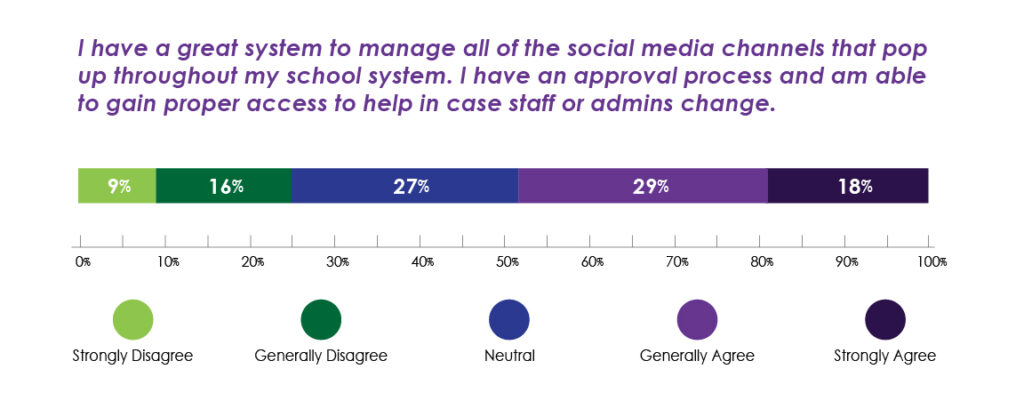
I have a great system to manage all of the social media channels that pop up throughout my school system. I have an approval process and am able to gain proper access to help in case staff or admins change.
- 9% – Strongly Disagree
- 16% – Generally Disagree
- 27% – Neutral
- 29% – Generally Agree
- 18% – Strongly Agree
I’m so glad that many schools have a system in place to stay on top of these channels! This is especially important when you have staff and coach turnover. You don’t want an account to suddenly go quiet, and you don’t have admin access to keep it going.
For the 25% of you who don’t have anything in place to track affiliated accounts, this would make an excellent summer project. This blog breaks down how to create a social media directory for your school.
Q12: Do You Allow Comments on Social Media?
It’s very important to have your social media accounts grounded in commenting guidelines. This can become a question of freedom of speech and open records requests, since your channel can function as an online open forum!
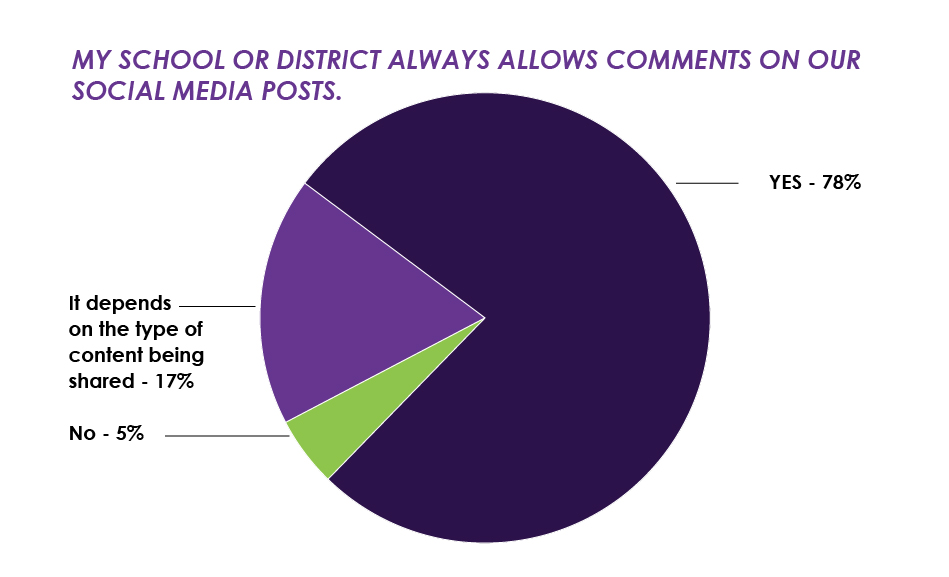
My school or district always allows comments on our social media posts.
- 78% – Yes
- 5% – No
- 17% – It depends on the type of content being shared
While most comments on school social media accounts are positive, I recently spoke with a colleague who said it’s been really hard in 2026. Between the political climate and people feeling like they can say anything they want, that often spills over onto our school pages.
I get it; it can be very challenging.
At #SocialSchool4EDU, we have had to help schools shut off comments, often just temporarily, if there is a crisis or backlash going on. But Facebook doesn’t make it easy to enable this feature, because the platform wants interaction on its platform! At the time of writing this blog, you have to turn off commenting on every post when it goes live.
If your district leadership raises the possibility of limiting social media comments, you can refer them to this data to show what most schools are doing. This will be helpful in your decision-making process. And we always recommend involving your legal counsel when making these decisions.
Q13: How Are You Involving Students as Social Media Contributors?
In 2025, 41% of respondents reported using student contributors. That number grew to 48% in 2026!

Have you involved students in your social media content generation?
- 48% – Yes
- 52% – No
I feel like I’ve done my job in encouraging social media managers to tap into the power of student storytellers! I’m so proud of everyone who has stepped up to the challenge this year.
Our students are close to current video trends and bring such creativity to the table. In many cases, they also have the time to help you. In short, student contributors are a powerful asset for your social media team!
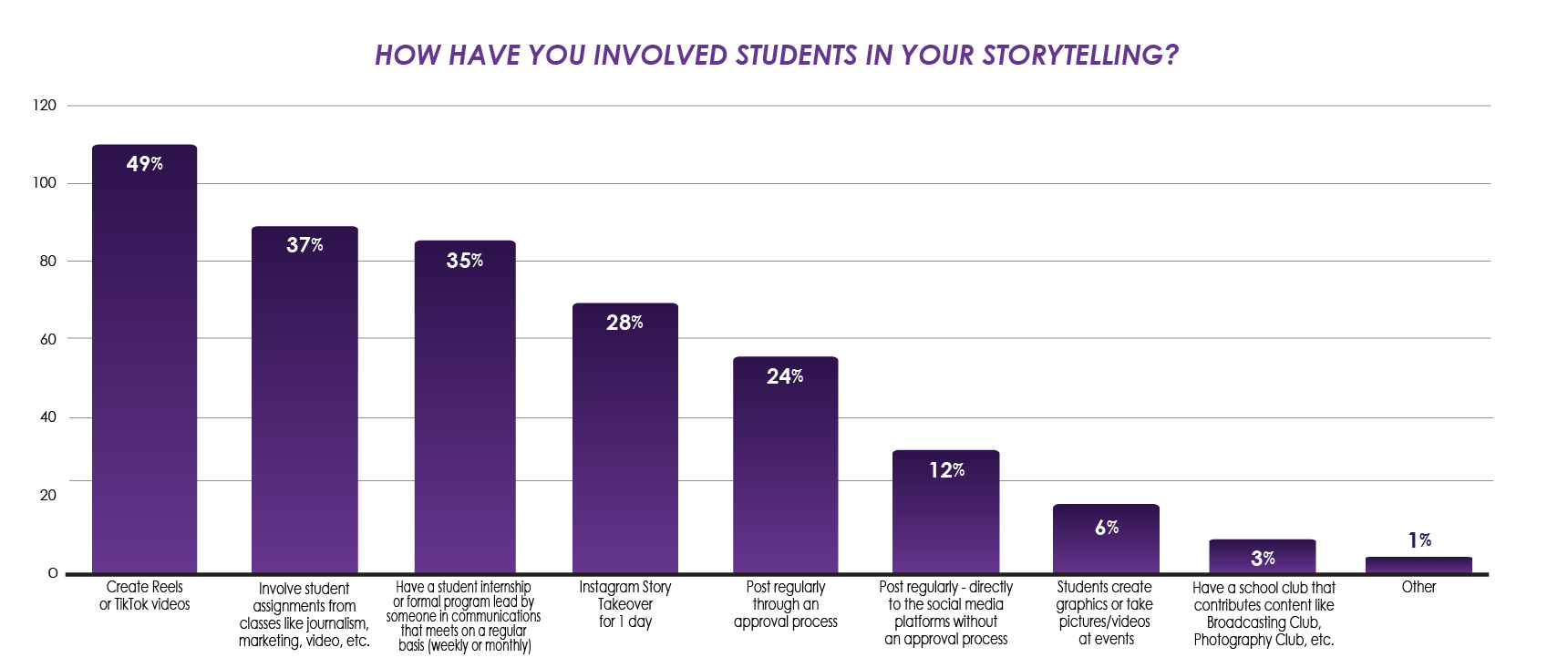
How have you involved students in your storytelling?
- 49% – Create Reels or TikTok videos
- 37% – Involve student assignments from classes like journalism, marketing, video, etc.
- 35% – Have a student internship or formal program led by someone in communications that meets on a regular basis (weekly or monthly)
- 28% – Instagram Story Takeover for 1 day
- 24% – Post regularly through an approval process
- 12% – Post regularly- directly to the social media platforms without an approval process
- 6% – Students create graphics or take pictures/videos at events
- 3% – Have a school club that contributes content like Broadcasting Club, Photography Club, etc.
- 1% – Other
Need a place to start with student contributors? Start with what 49% of your colleagues are doing – short-form videos! Reels and TikTok videos are right up a teen’s alley. Have an upcoming event? Instead of posting a flyer, assign students a video like one of these! And I’m willing to bet that they’ll have plenty of their own ideas, too.
See that 37% up above? If you don’t have time to take charge, talk to some teachers about working social media into their curriculum. I love seeing students doing job shadows, internships, CTE programs, or work apprenticeships while they’re in high school. There are so many stories out there!
If you’re interested in watching a free webinar on this topic, check out 12 Tips for Unleashing Student Storytellers in Your School.

If you answered no to above, why haven’t you involved students in your storytelling?
- 53% – I’m too busy to take this on.
- 31% – I want total control over the social media channels. The decision is really up to me.
- 31% – I don’t feel like I have the controls or tools to moderate what the students are posting.
- 26% – My administration will not allow this.
- 20% – I’m just nervous.
- 6% – Students are too young or don’t have the capability
- 6% – Students are not allowed to have cell phones
- 5% – Not enough student interest
I completely understand these reasons. But what if, instead of looking at what you can’t do, you consider what you can do? If you’re worried about control, there are tools that can help you moderate content created by others, such as Class Intercom. Or, you could easily have your student contributors email you content to post.
Mahtomedi Public Schools’ Director of Communications, Alice Seuffert, is a one-person school PR shop. But her intern has expanded her capacity, and you should check out the volume and quality of stories she can celebrate. That could be possible for you, too! Have I convinced you to give it a try?
Q14: What Are Your Avenues for Professional Development?
While just about everyone who participated in this survey is a #SocialSchool4EDU email newsletter (thank you!), there are tons of other avenues for pursuing professional development for your role. Take a look:
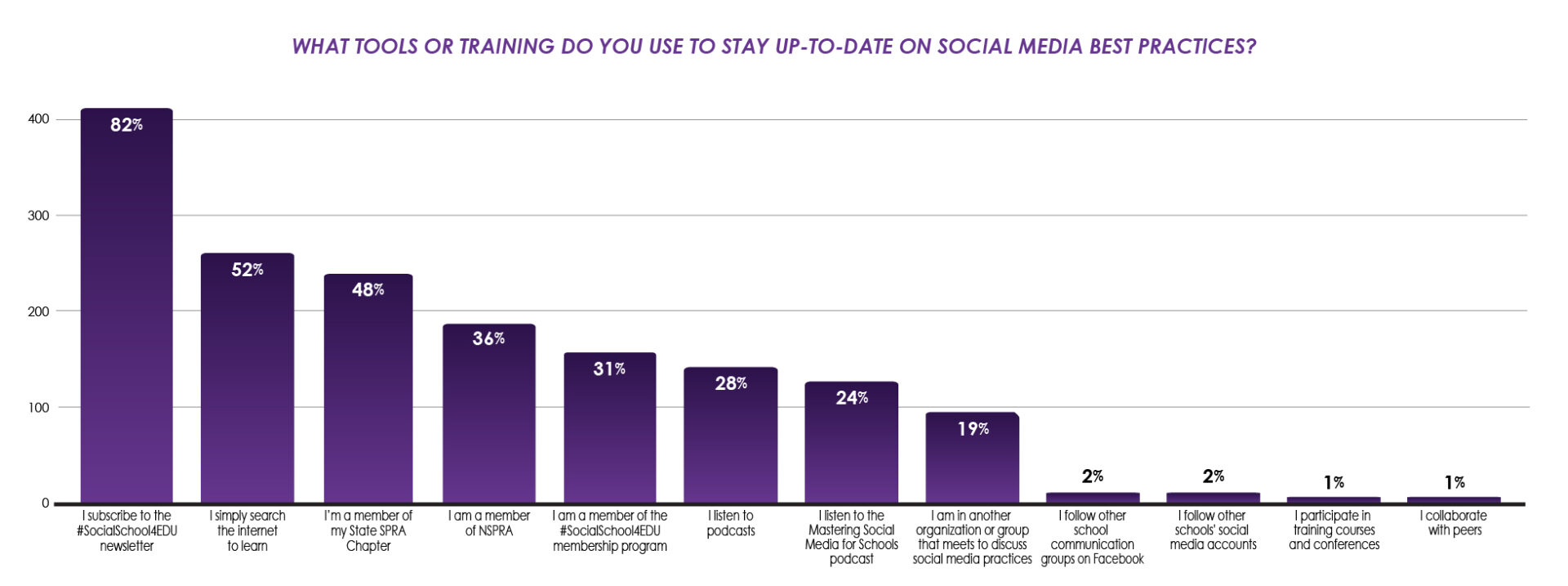
What tools or training do you use to stay up-to-date on social media best practices?
- 82% – I subscribe to the #SocialSchool4EDU newsletter
- 52% – I simply search the internet to learn
- 48% – I am a member of my state SPRA (School Public Relations Association) chapter
- 36% – I am a member of NSPRA (National School Public Relations Association)
- 31% – I am a member of the #SocialSchool4EDU membership program
- 28% – I listen to podcasts
- 24% – I listen to the Mastering Social Media for Schools podcast
- 19% – I am in another organization or informal group that meets to discuss and learn the latest social media practices
- 2% – I follow other school communication groups on Facebook
- 2% – I follow other schools’ social media accounts
- 1% – I participate in training courses and conferences
- 1% – I collaborate with peers
Here’s where you can access some of the resources mentioned in the survey responses:
- #SocialSchool4EDU email newsletter
- #SocialSchool4EDU membership program
- Mastering Social Media for Schools podcast
Q15: What Are Your Goals for Social Media this Year?
The final question we asked was about your goals, as you finish 2025/2026 strong and look ahead to 2026/2027. Most of these answers haven’t changed over the years that we’ve been doing this survey:
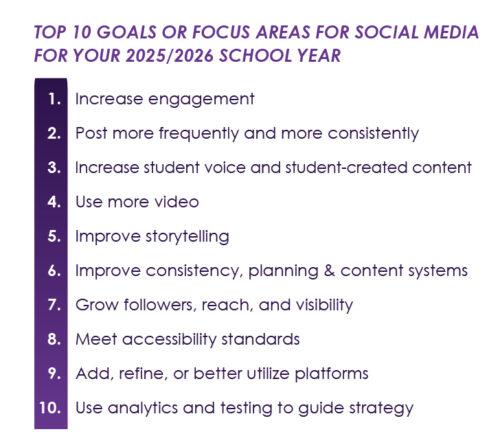
Top 10 Goals or Focus Areas for Social Media for Your 2025/2026 School Year
- Increase engagement
- Post more frequently and more consistently
- Increase student voice and student-created content
- Use more video
- Improve storytelling
- Improve consistency, planning & content systems
- Grow followers, reach, and visibility
- Meet accessibility standards
- Add, refine, or better utilize platforms
- Use analytics and testing to guide strategy
I love these goals! Which ones resonate with you? Here are some resources to help with the top-listed goals:
Increase Engagement / Use More Video
These goals really go together, because the best way to increase engagement is to lean into short-form vertical videos! Start with these five blogs:
- How to Leverage Instagram Reels Trends
- 2025 Golden Gribble Award Winners
- 2025 Golden Gribble Honorable Mentions
- Five Categories of Instagram Reels to Try at Your School
- How to Create Authentic Content with the Hallway Mic Trend
By the way, if you ever share something awesome, email it to me! You never know when one of your posts might show up in my newsletter or social media pages as a great example.
Post More Frequently and Consistently
As you aim to create more content, it all starts with having a system. Read my book for a step-by-step process for gaining staff buy-in, and/or begin with these eight high-impact, tried-and-true post ideas.
Increase Student Voice and Student-Created Content
Here’s another sweet spot for highly engaging content! Start here:
How Are You Going to Use These Results?
That’s a wrap on our 2026 survey. I want to thank each of our 497 respondents for giving their time. Your insights make all of us better!
What did you think of this data? My hope is that it’s meaningful information that you can apply to your school communication efforts. Your next step is to subscribe to my podcast, “Mastering Social Media for Schools,” because I have a TON of amazing guests lined up for you. We have new episodes every Monday! See you there.