

Staring at an empty social media calendar can feel overwhelming, especially when trying to plan your school’s content for the weeks and months ahead!
That calendar is just itching to be filled with engaging posts, key announcements, and those special moments that make your school so unique. But as a school communicator, you’re juggling dozens of responsibilities, and sometimes just knowing where to start with social media planning can feel like the biggest hurdle!
Here’s the good news: You don’t have to figure this out alone. Some of the brightest minds in school communications have developed systems that take the stress out of content planning, turning that intimidating blank calendar into an organized roadmap for success. The system is all about developing custom content themes for your school, and you’re going to learn exactly how to do it in today’s blog!

So today, I want to share a brilliant, tried-and-true strategy that Susan Brott, APR, Senior Communications Strategist at CESO, and Alice Seuffert, Director of Communications at Mahtomedi Public Schools, recently shared in my membership program. I can’t squeeze everything from their in-depth workshop into this blog, but today’s article will give you everything you need to get started!
Step 1: Define Your Brand
Before you even start working on your content themes, take a step back and use your school district’s brand as a foundation. Susan and CESO help districts across the country uncover their brand in a comprehensive branding process, which Alice and Mahtomedi Public Schools did in the spring of 2023. According to Susan, your brand should communicate:
- Who you are
- What you do
- How you make a difference
Alice regularly reiterates the importance of aligning your social media and overall communications strategy with your brand to build trust and achieve enrollment success. She shared, “When your content and communications are aligned with your brand, people are more likely to find you, connect with you, and develop deep roots.” According to Harvard Professor Gerald Zaltman, 95% of our purchasing decisions are made in the subconscious mind. What does this mean for school communicators? According to Iconic Fox, “When brands with a strong ‘archetypal personality’ connect on an emotional level with their audience, they have a massive advantage over their competition.”
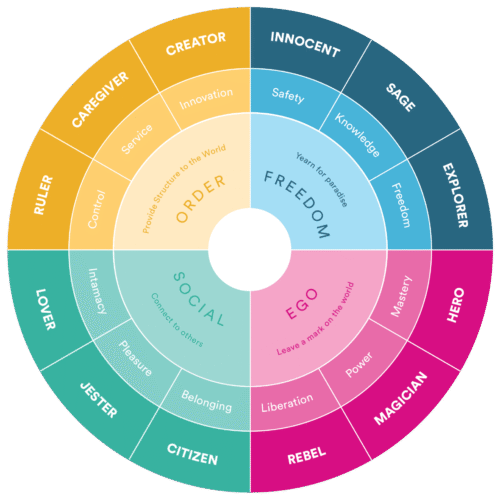
According to Susan, understanding your brand means understanding brand archetype, a concept based on the work of psychiatrist Carl Jung. Your brand archetype informs the personality of your brand, profiling its aspirations and motivations. Brand archetypes transform your school into a relatable character that people can understand and connect with. There’s so much research and information about archetypes, just do a quick search and you’ll learn so much about these unique brand characters. There’s not one best archetype; it’s really about uncovering which one is your district!
Need Help? Use ChatGPT!
Alice presented Strategic Storytelling at our Social Media retreat in 2025 and developed a custom ChatGPT prompt for attendees and our members to help uncover their brand archetype (while a comprehensive brand process is best, if you need to start to uncover your brand this tool can get you started). It’s a two-part prompt that is available within our membership program:
- The first prompt guides you through a series of questions to deeply understand your brand identity, archetype, and strategic priorities. After learning about your school’s unique characteristics and analyzing your current social media performance, ChatGPT creates 50 tailored content ideas. All content suggestions are carefully aligned with your brand identity and strategic plan, focusing on authentic community connection rather than fleeting trends.
- The second prompt builds on this foundation by organizing your content into 10 clear theme areas, providing a practical framework for your school’s storytelling. This structured approach ensures your social media presence remains consistent, strategic, and true to your school’s mission.
Step 2: Plan Your Content Themes
After digging deeper into your school district’s brand archetype, you’ll have a much better idea of who you are as a district and the social content that best represents your district. You can use this information to develop a themed monthly content calendar that is based on your brand or even just more strategically aligned posts, every week.
Does your school have a Portrait of a Graduate? Strategic Plan? A “why enroll” or an “about” page on your website? Your themes could be right there for you, too!
If you want to develop a monthly plan, once you have your themes (Alice typically selects 10 to cover from September to June), you can choose the themes to accompany each month and provide a brief summary of what that theme represents in your district.
For example, themes under the brand archetype Caregiver could include:
- September: Student-centered learning – Your school personalizes learning to meet students where they are, especially in high school. From real-life work experiences to flexible academic options, students are set up for success beyond graduation.
- October: Family-like structure – 4-year-olds high-fiving seniors is normal here. Cross-age interactions are everyday magic, showcasing mentoring, shared learning, and real connection.
- November: Staff who love what they do – You have “local experts” on staff who care deeply about students. Your small-town roots and internal training culture create a powerful force for student success.

Step 3: Communicate Your Themes
As you develop your content themes, are you starting to think of some post ideas that could fall into those themes? Again, your friend ChatGPT can help you think of specific posts that will help you communicate those ideas through social media content!
Your next step is to communicate your themes to your colleagues and district partners, so they can help you generate content that aligns with those ideas.
Alice shared this important insight about getting brand-based stories from staff: “Not everyone is a communicator or storyteller, and your educator colleagues don’t always see the incredible story in what they are doing. The content themes can help you connect with them to leverage their educator expertise alongside your own as a communicator, so you can create strong brand-based content together.”
Alice recommends that you regularly email your staff about the themes and provide examples of the submissions, as well as the success that comes from sharing. (This post reached 2,000 people!) Don’t forget to email thank yous to your staff and the links to the posts they helped you create. This helps you build trust with your colleagues that you use the content they share.
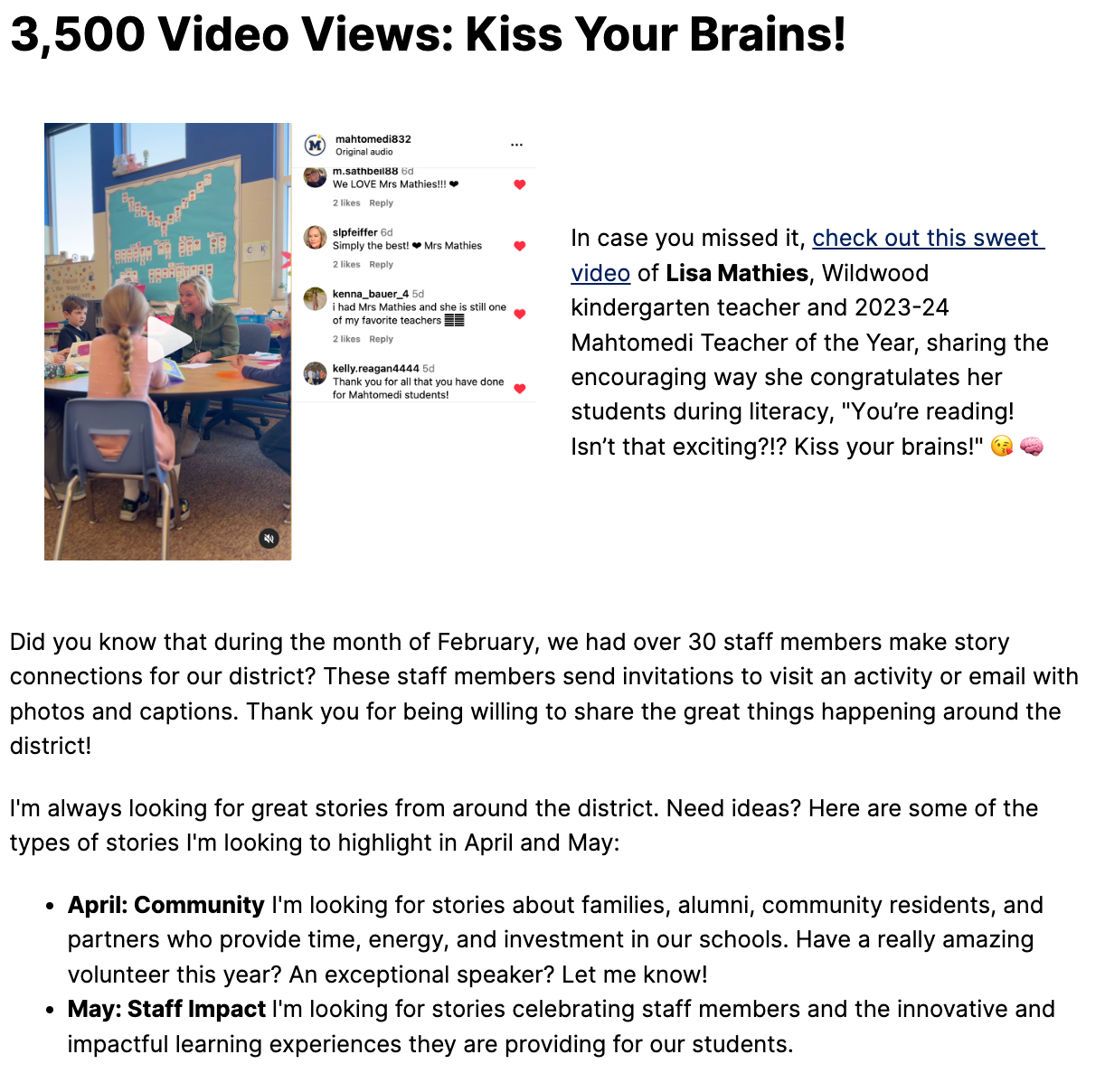
Here is an example of one of the emails that Alice sent out to staff. Note how she communicates upcoming themes after sharing the success of one of the stories she shared.
Email text:
3,500 Video Views: Kiss Your Brains!
❤️ In case you missed it, check out this sweet video of Lisa Mathides, Wildwood kindergarten teacher and 2023-24 Mathomad Teacher of the Year, sharing the encouraging way she congratulates her students during literacy, “You’re reading! Isn’t that exciting!?? Kiss your brains!” 😘🧠
Did you know that during the month of February, we had over 30 staff members make story connections for our district? These staff members send invitations to visit an activity or email with photos and captions. Thank you for being willing to share the great things happening around the district!
I’m always looking for great stories from around the district. Need ideas? Here are some of the types of stories I’m looking to highlight in April and May:
- April: Community I’m looking for stories about families, alumni, community residents, and partners who provide time, energy, and investment in our schools. Have a really amazing volunteer this year? An exceptional speaker? Let me know!
- May: Staff Impact I’m looking for stories celebrating staff members and the innovative and impactful learning experiences they are providing for our students.
Staff aren’t the only ones using the themes at Mahtomedi Public Schools; Alice has her intern team work on projects aligned with the themes, and district partners like Community Education also use the themes for collaborative social media posts and articles.
Step 4: Evaluate Your Results
Once you have your content calendar in place, track the results to help you understand what is going well and ways to improve over time.
What should you track each month?
- Track your staff-submitted, theme-based stories (this will also be helpful for thank yous)
- Track your partner and intern-created theme-based stories
- Review your social media reach (unique persons seeing your content) each month
- Review your top posts and the themes you see in the posts
- Use ChatGPT to be your partner and review with you what’s going well and areas of growth for your social media (Alice shared at the Social Media retreat, she likes to review the positive too, each month)
Looking for proof that this method of content planning works?
Know that it takes time and consistency to see results. Alice’s work on the social media accounts at Mahtomedi Public Schools has been years in the making, and it’s paid off. In addition to an increase in staff-submitted stories, their district has enjoyed significant growth in both Facebook and Instagram over the last three years.
- A school district’s reach should ideally be between 3-5 times their followers each month on social media, and Mahtomedi Public Schools’ monthly reach ranges from 3 to 21 times their followers on Facebook and 3 to 11 times their followers a month on Instagram.
- Since Alice is based in Minnesota, she quantified their impact by asking you to imagine their Vikings Football stadium, U.S. Bank, which holds 66,000 people. “Our reach this year on social media is like filling the stadium multiple times. (Instagram 2.5 and Facebook almost 5 times). I’m really proud of those numbers, and it shows the impact of sharing the great work we are doing at Mahtomedi Public Schools.”
Mahtomedi Public Schools also incorporates its content themes into its Instagram Reels. During the 2024-25 school year, they shared 107 Reels with over 350,000 views of their content.
Your Turn: Translate Your Brand’s Personality into Tailored Social Media Content
Creating on-brand social media content doesn’t have to be overwhelming. In fact, when you break it down into these strategic steps, it becomes an engaging process that helps you tell your school’s story even more effectively!
Ready to take your school’s social media presence from overwhelming to outstanding? Start with just one theme, one month at a time. Your authentic brand voice will shine through, and your community will notice the difference!
Let’s see your work! Have you put content themes into action? We’d love to hear from you! Email us at andrea@socialschool4edu.com and we’d love to feature your work!