
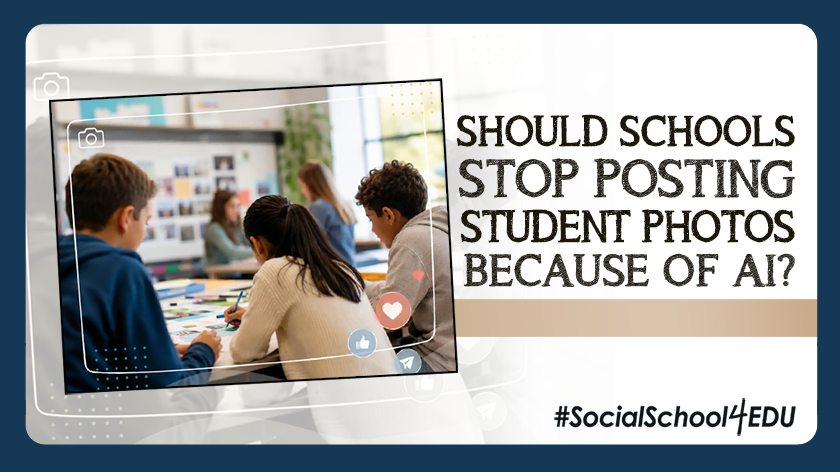
Can schools safely share student photos in the age of AI?
Now that’s a loaded question! A school communicator recently emailed me about this concern, and I decided to paraphrase the situation here because I know many of you are wrestling with this same question – or will be, in the near future.
He shared that he had spoken to not one, but two school safety consultants who are discouraging schools from posting student photos on social media because of the risk of AI manipulation. One recommendation went so far as to suggest using stock photos instead of real student images!
If that stops you in your tracks, you’re not alone.
The concern is definitely legitimate. AI tools are changing quickly! Photos posted online can be downloaded, altered, and redistributed without consent. Schools should absolutely take student privacy, consent, and safety very seriously.
But at the same time, this raises a very real question for school communicators: How are we supposed to promote our schools without showing our students?
School communicators are asked to communicate effectively, build trust with the community, support enrollment efforts, and celebrate students and staff. From a family perspective, they want to see what school actually looks like – before, during, and after their kids are enrolled!
Communities want transparency. Prospective families want proof of your culture. And yet, some schools are now being advised to pull back from the very images that make their storytelling real.
What should YOU do?
This isn’t a small issue. We can’t bury our heads in the sand on this one. It touches student safety, privacy, consent, ethics, cyber liability, internal review processes, and the growing realities of AI. We should all be thinking about this!
But I also believe this conversation needs nuance.
Schools should not ignore the risks, but at the same time, I do not believe the answer is to stop telling authentic stories about students and school life.
As my friend John Casper (Communications Coordinator for Winona Area Public Schools) shared in a recent webinar:
“When schools go quiet, we don’t create safety, we create distance. And the absence of communication doesn’t create calm, it creates speculation.”
Now that really hits the nail on the head. Schools absolutely can (and should!) continue telling their stories, but with thoughtful safeguards in place.
What should those look like? Keep reading to find out.
Digital Safety: Schools Need Safeguards, Not Silence
At #SocialSchool4EDU, this is how we approach the problem with the 80+ schools that hire us for full management services:
- We only share student images if they align with the district’s media release and opt-out process.
- We avoid unnecessary identifying details in captions unless there is a specific reason to include them, such as a formal recognition.
- We train our team to watch for names, ID numbers, schedules, and other visible personal information in photos before anything is posted.
- We encourage schools to use a mix of close-up, group, classroom, event, and project-based photos to ensure strong storytelling without overexposing individual students.
- We honor family’s wishes regarding images shared online. If they have concerns, photos of that student won’t be shared.
- We respect staff members’ concerns. If a teacher is uncomfortable sharing student images, we give them other ideas for photos – such as student work, hands-on activities, performances from a wider angle, classroom projects, and photos without visible faces.
Each of these six policy statements could work within your situation. They strike a balance between celebrating stories and respecting individual family concerns.
Another way to put it is to work through this short checklist. Make sure you have:
- A clear photo/media consent process
- Documented internal review expectations
- Staff training on what not to include in images or captions (this blog will help!)
- A plan for honoring parent and staff opt-outs quickly and consistently (see this example)
Making a Case for Why Schools Still Need Real Photos on Social Media
Now, what about the conversations you’re having with administrators, staff members, families, and the wider community? Even if you have rock-solid policies in place, there will inevitably be further questions and concerns!
There’s room for thoughtful discussion in this area. I can’t tell you what to say or what to believe, but I can share an opinion that may help you with those conversations. I’ve been working in school social media since 2014, so my perspective here may reflect what you also know to be true:
 We live in a world where schools are expected to communicate visually. Families and communities want to see learning in action. When done thoughtfully, school social media builds trust, celebrates students and staff, supports enrollment, and helps the public better understand what is happening inside the school.
That’s why schools need to be on social media. Social media is where our stakeholders spend time online, so as long as we use these platforms responsibly, we need to use them.
Yes – the risks are real, and they deserve attention. But I would not recommend pulling back from student storytelling altogether. Instead, refine the process so you can continue to share in a way that aligns with school policies while still telling stories.
As a leader in your district, you set the standard. Take this as an opportunity to demonstrate how social media can be used in a responsible way!
Put your safeguards in place, train your team well, and keep telling the stories of your school. Students deserve to be celebrated, families deserve to see what’s happening, and your community deserves an authentic window into school life.
Don’t let fear push your school into silence! There is still a place for authentic school storytelling. In fact, I would argue we need it now more than ever. Let’s do it thoughtfully, responsibly, and without losing sight of why it matters.
I’ll close with one more wise quote from John Casper: “When we celebrate students in ways that honor their humanity and their families’ wishes, positivity becomes an act of care, not a performance.”